

it doesn't end at the trees
AWP 2024-2026

Saturday
I was right about needing an alarm this morning. The dream I am in the middle of when my watch buzzes is hard to pin down even in the moments before I flex my fingers and remove the single earplug I sleep with.
Last night, Emma overheard me talking about my earplug. I was telling Deena I don’t need two since the ear against the pillow isn’t the one doing the hearing. I have developed the ability through the night to remove the earplug from the exposed ear, flip over and pop it in the other without waking up. Sometimes this happens a few times in the night; last night I think not at all. Emma had heard a horror story about a sleeping earbud wearer, she said, who had woken to find their inner ear atrophied, the blood supply permanently cut off. It’s not something I’m going to overthink, having only just discovered earplugs, I said. She backtracked when she saw whatever my face was doing. She was sure that the ones designed specifically for sleep are fine. I don’t mention how many of my waking hours are spent with the blood-supply-cutting-off type in my ears, nor the force with which I often tap them, the right one in particular, when I’m impatient with my playlist.


I don’t like goodbyes. I often make a joke of them; of moments that call for sincerity in general. Perhaps it’s the red wine, the whisky poured over ice from a bottle called Writers’ Tears or the cumulative, giddying impact of too many nights with too few hours’ sleep but as I get out of bed, I’m hit by a wave of dread for the way I approached Caroline last night. It was a moment when the whisky, at least, was still a way off and she had been standing back from the group, her eyes on a few of her poets. Her face was set with pre-emptive grief for the end of the two years together, which will culminate officially in a week or so but felt finished last night in all the ways that really mattered. I interrupted her thoughts, approaching her and calling her “mother”. Why couldn’t I leave her alone to have a private moment thinking about the writers she’s nurtured for two years, poured so much of herself into? I could offer myself compassion; it was just the fangirl part of me. I’m not into women but maybe there’s a part of me that’s into her. I suspect no, I know, I wouldn’t be the only one.


Yesterday morning, it wasn’t hard at all to get out of bed. My thoughts through the night, when I woke up, switched sides and the earplug, had been about the gifts and the cards the 15 of us needed to yet organise. I sent a message to the group chat before 6.30am saying I was going to run into the village after the morning’s sessions to remedy it and had felt better for taking action. In a nice gift shop in the village, things that had seemed nice and appropriate when I’d first nipped in on Monday now seemed twee, mass-produced, irrelevant, inadequate. It only had to be what we call in Scotland a wee minding because there are other gifts for our tutors – the personal kind, the in-joke kind, the kind they might keep and use and think of us when they do. The greatest gift is our combined gratitude which cannot, of course, be expressed in objects, in chocolates, even in words; unless those words are eventually acknowledgements at the back of our published books, perhaps.


Some hope next week’s industry event in London has the potential to change lives. I remain circumspect, unsure whether I believe an evening, however grand, has that power. I’m more believing in the power of change that has come from spending two years with a group of excellent minds and hearts. It’s a change that is both felt and witnessed. Written and read.
A word on writing groups: when you have found people you can trust with your words – by which I mean your heart, your secrets – hold on tight and do not let go.
We workshopped extracts from one another’s manuscripts this week, digging deeper into short sections of our works-in-progress. Sections that constitute just a 60th, a 70th of the sum total of words in our books. At times, it’s been daunting, imagining the energy, effort and commitment that might be required if every 1000 words is to undergo this level of scrutiny, which in my fearful moments I’ve worried I don’t have the stamina for. The answer is perhaps simpler; the learnings from acting as editor for others and synthesising multiple writers’ feedback on our own work will undoubtedly influence the work that is yet to come. The sessions were supportive, questioning, dispassionate in the kindest sense of the word with an aim to get the work into the best possible shape.


No one cried, or at least I didn’t see them cry. However, when asked to explain my work, my thinking, my ambitions for the three-year project that I’ve returned to this week and have had, at more times than I can count, an ambivalent relationship to I found myself welling up. I’ve long asked questions of myself and in discussions with other writers about what kind of writer I want to be; how I’d like to position myself. It all feels of little consequence in a workshop room with the others, all of us pouring ourselves into nonfiction projects and stories that must be told. So what if I have literary ambitions that feel at odds with the nonfiction work I’m trying to sell? So what if my ego is blasting away, diminishing the literary merit of the work, saying it’s serviceable, fine, Ronseal. That’s the point. It’s what the project needs and demands. Inclusivity, access, readability. I can be abstract, avant garde, in my fiction.
At points this week, we’ve privately and collectively reflected upon the first days of the course, back at Totleigh in Devon in late summer 2024. Remember that minibus from the train station, I said. Remember how quiet you were, Tom? I think but don’t say that I remember him smoking alone outside during that first week, too. He had been juggling other work – as had some of the others who have freelance, multistrand careers – and had appeared under pressure. By the following autumn, he wore a gold and black hairband that some of us took turns to put on when we shared new work. The keeper of the crown.
Now that we’ve been intimately invited into one another’s interior lives in ways not many would, we are the keepers of much else. Our ongoing conversations are about Sarah Jessica Parker, Donatella’s facelifts and camp trophy-wife fantasies as much as they’re about grammar, syntax and subtext and — last night — some of us laughed so hard round the kitchen island unit about a misheard acronym that Tom threatened to be sick all down his gold silk shirt. It goes without saying that by that point, we’d drank all of the Writers’ Tears, all of the red wine, eaten all of the brownies and all of the cheeseboard, if not quite drank all the water in the tap.


What I remember of that minibus – Fiona jumped in – was you two knowing one another. She was pointing to me and Morag. I was thinking, oh fuck, everyone knows one another here. That’s when I thought I didn’t belong on the course. We remind her first that we had only met once before, at the launch of a mutual friend’s poetry collection, and second that we all had our moments of imposter syndrome.
Mine, I told them, came later that night when Caroline did that thing that she and Cal would go on to do many, many times over. OK, seven minutes: Go! What was the prompt? Becky remembers – It was “When no one is watching, I…” We nodded, yes, that was it. I had stared at those words with no idea what to write, the clock ticking. I tell them in a plodding voice all the dull, things I wrote that I literally did when no one was watching and we laughed. The poets and the fiction writers — no, actually everyone but me — I recalled, came out with all this fantastical yet entirely clear-sighted, vivid and believable stuff, building worlds in a single breath, having us follow the internal logic as a line led to another and another, and there I had been with my dead skin and my nasal drip.
Fuck, though, we’ve all had those moments, Oliver – one of the aforementioned poets – said, and I knew he wasn’t just being nice. We have. For me, perhaps only this past week have I felt that I truly have been in the right place all along. Is that sad, or just part of the process? As it should be, when we’re at the end of something? A sign maybe we’ve grown into what we have been hoping to grow into all this time, before we try on the next pair of shoes, that will inevitably and rightly feel too big to start with.
At the final sharing last night, I read some of the novel I’m working on. Afterwards, and after I’d interrupted her reverie with the mother comment, Caroline complimented me on how my work has changed. You’d said two years ago you wanted to be destroyed, she reminded me.


Yes, I agreed, but I’m just a novice with this fiction, trying my hand. I motioned towards some of the novelists in the room, nearly finished their manuscripts and so sure of their voice, their skill. Oh come on, you’re more than trying your hand, Lindsay, she said. Your hand is very… and then she gestured, not often lost for the right word but I blamed the wine I poured for her earlier which was more than the thimble-worth I’d said it was. Your hand is very. It’s very! That’s it. We high five, me mimicking her explosive body language in that way I do when I’m around her. Put that on my tombstone or cryogenic chamber or whatever, I said back.
So with my very hand, onwards. First, home. Then next Monday to Somerset House and beyond that to finished manuscripts and queries and submissions and auctions and acquisitions and announcements and rights and quarterly payments and interviews and articles and podcasts and prizes and panels and chairing and teaching and editing and judging and writing and finished manuscripts and
/ or to families and spouses and children and parents and dishes and laundry and cleaning and working and studying and performing and translating and reading and making and exercising with a little bit of writing when we can.


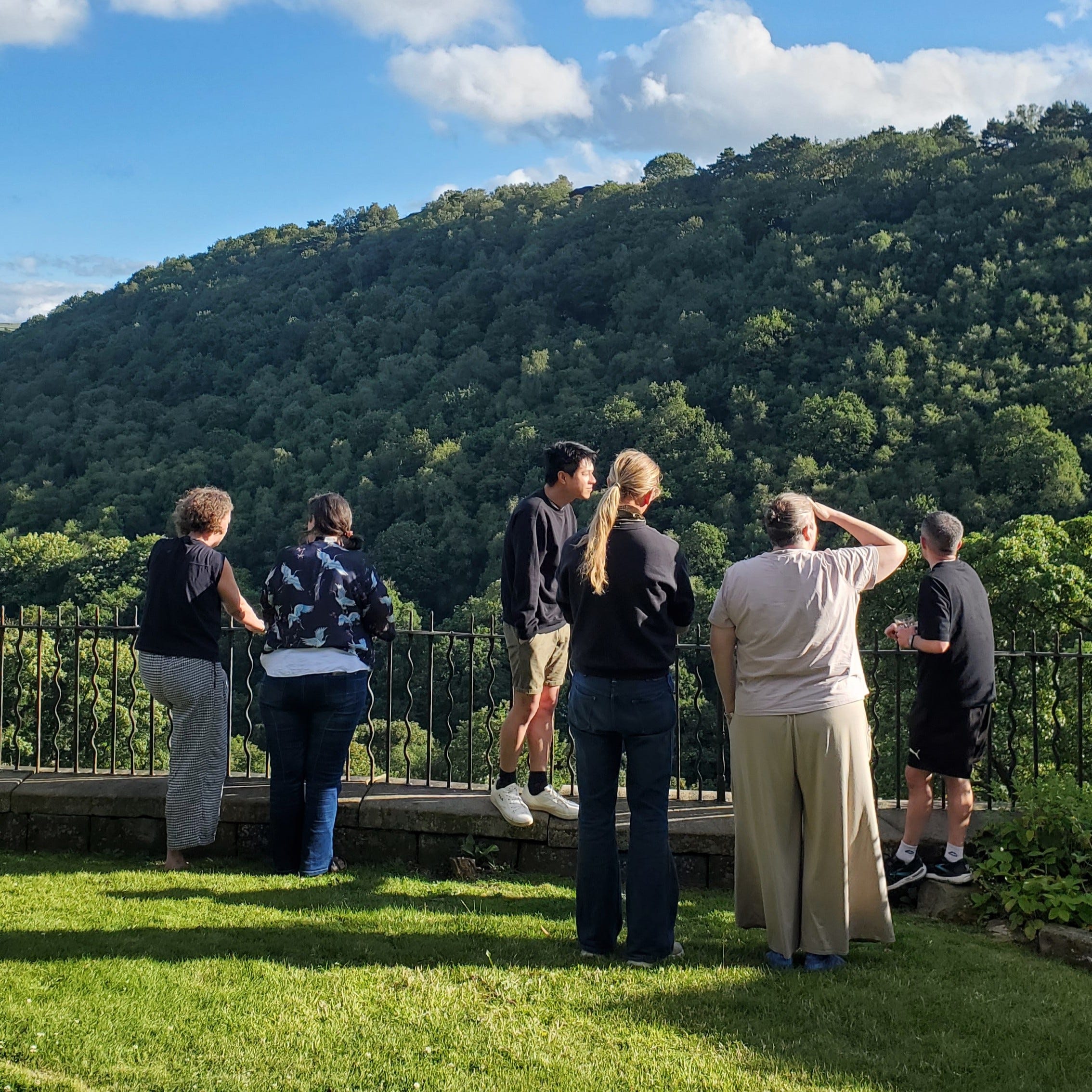
On Wednesday, which we used to call the rickety bridge day, Morag looked out from Ted Hughes’s old garden at the front of Lumb Bank and across the valley to the dense patch of forest. You know, it doesn’t end at the trees, she said of course meaning the view and much else metaphorical besides. This would be repeated by others to me, to us, on the days that followed. We’re ramping up not wrapping up, another wise woman once said.
And no, it doesn’t end at the trees.
You are a marvel: a deep feeling capturer of details. You are a poet, a chronicler, a spokesperson for the soul. I love you, Lindsay.
A beautiful account of a life-changing experience. Wishing you all the best as you carry this forward.